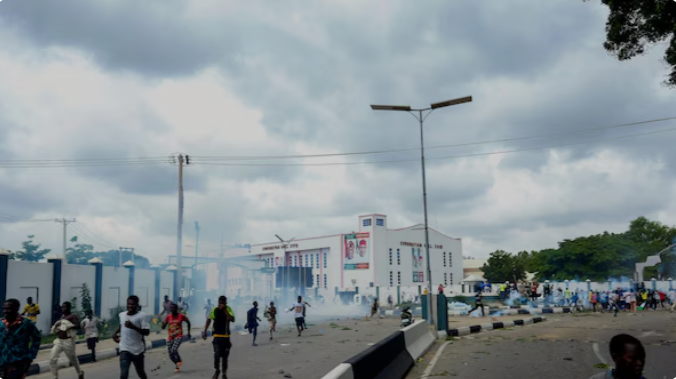
Twenty-nine children in Nigeria could be facing the death penalty after being charged for participating in a protest against the country’s soaring cost-of-living crisis. The children, aged between 14 and 17, were arraigned on Friday alongside other protesters and charged with multiple felonies, including treason, destruction of property, public disturbance, and mutiny. Four of the minors reportedly collapsed in court from exhaustion before they could enter their pleas.
A total of 76 protesters were detained in connection with the demonstrations, which have become more frequent in response to the severe economic conditions affecting millions of Nigerians. In August, similar protests resulted in the deaths of at least 20 people, with hundreds more detained after rallying for better job opportunities and improved living conditions.
Legal experts argue that sentencing minors to death would violate Nigeria’s Child Rights Act, which prohibits criminal proceedings and the death penalty for children. “Taking minors before a federal high court is wrong, ab initio, except if the government is able to prove that the boys are all above 19 years,” said Akintayo Balogun, a lawyer in Abuja.
The court eventually granted bail for each defendant, set at 10 million naira (around $5,900), but the strict bail conditions have not yet been met, according to Marshal Abubakar, who represents some of the minors. Abubakar highlighted the harsh treatment the children have endured, noting they had been held in detention for 90 days, often without food. “A country that has a duty to educate its children has decided to punish them,” he added.
Yemi Adamolekun, executive director of the civil society organization Enough is Enough, criticized the authorities for prosecuting children. “The chief justice of Nigeria should be ashamed; she is a woman and a mother,” she said, questioning the morality of the prosecutions.
Despite being one of Africa’s top oil producers, Nigeria is also one of the world’s poorest countries, with widespread corruption exacerbating inequality. While public officials enjoy substantial salaries and benefits, much of the population faces poverty, inadequate healthcare, and food insecurity. This contrast has fueled frustration among citizens, particularly as inflation reaches a 28-year high and the naira continues to depreciate against the dollar.
Nigeria’s economy has also been further strained by its population of over 210 million, making it one of the most food-insecure countries globally. Just last week, the United Nations designated Nigeria as a “hotspot of very high concern” in a report highlighting the nation’s critical levels of acute food insecurity.