In a recent move signaling Russia’s growing influence in West Africa, up to 200 Russian military instructors have reportedly been deployed to Equatorial Guinea to reinforce presidential security, according to sources cited by Reuters. This deployment highlights Moscow’s continued expansion in the region despite facing recent setbacks in Mali.
Sources confirm that the Russian personnel are training elite guards in Malabo, the capital on Bioko Island, and in Bata, located on the mainland. These trainers are said to be focusing on strengthening security in the oil-rich country of 1.7 million people, where U.S. energy giants once invested heavily before reducing their presence. This deployment adds to Russia’s broader efforts in West and Central Africa, where Russian mercenaries support military regimes against insurgencies, filling the void left by diminishing Western influence.
For Russia, such missions offer both financial rewards through government payments and potential economic opportunities in sectors like mining and energy. This strategy is also seen as part of a broader global power struggle between Russia and the West, played out most visibly in Ukraine.
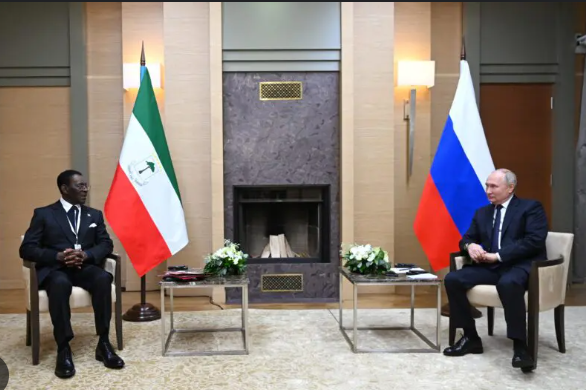
Equatorial Guinea’s President Teodoro Obiang Nguema Mbasogo, who has ruled since a 1979 coup and is grooming his son Teodoro Nguema Obiang Mangue as his successor, may be using Russian security to ensure the ruling family’s grip on power. During a Moscow visit in September, Obiang publicly thanked Russian President Vladimir Putin for providing “instructors” to bolster national security, as reported by TASS.
Reuters sources — including diplomatic and opposition contacts as well as civil society members — confirmed a Russian presence in the country, estimating 100 to 200 Russian personnel arrived over the past two months. Some sources noted possible involvement of Belarusian troops and identified one soldier from an elite Russian paratrooper unit. They also suggested that many of the personnel belong to Africa Corps, a Kremlin-affiliated paramilitary force increasingly active in the region.
Reports indicate that these Russian contractors are stationed in key locations, Malabo and Bata, to protect high-ranking officials, notably Obiang’s son Teodoro, the wealthy vice president and likely heir. Teodoro has faced international scrutiny, including sanctions and asset seizures by the U.S., France, and Britain, on allegations of embezzlement and money laundering.
The Russian mission in Equatorial Guinea was preceded by recruitment ads for security roles there, posted on pro-military Russian Telegram channels in June. These ads offered six-month contracts with monthly pay between $3,000 and $5,000, with options for payment in cash or cryptocurrency. Images of foreign troops, identified by Russian flags on their uniforms, have since been published by the Spanish news organization Diario Rombe.
In recent years, Russian influence in Africa has grown through deployments by the Wagner Group, which has operated extensively in Central African Republic and Mali. However, Wagner suffered major losses in northern Mali in July, prompting Moscow to increasingly rely on the Kremlin-controlled Africa Corps, now deployed in countries like Burkina Faso and Niger.
Equatorial Guinea, once a major oil producer with daily outputs exceeding 300,000 barrels, now produces around 80,000 barrels a day, having seen waning U.S. investment over the years. However, on September 27, Russia’s Interfax reported that Equatorial Guinea and Russia had discussed new agreements for Russian companies in the country’s oil and gas industry.
A spokesperson for the U.S. State Department has urged Equatorial Guinea to avoid partnerships with Kremlin-backed defense groups, warning of potential “serious consequences” under U.S. law. Russia’s moves in Equatorial Guinea come as President Obiang, who has survived multiple coup attempts, looks to solidify his hold on power amid shifting alliances in the region.